

Artificial Intelligence has barely touched emergency response in high-hazard sectors. Jonny Price examines the case for and against.

For over 25 years, Berwicks has been developing resilience through focusing on the human element of an emergency. This has not changed, as at the end of the day, humans still make the decisions (for now…). However, the environment around us is changing, and technology, specifically Artificial Intelligence (AI), is evolving exponentially. Yet, we (Berwicks) have not seen AI adopted for emergency response within high-hazard industry in the UK.
Given the high-consequence nature of these environments, is this caution justified? Or are we overlooking a technology that has the potential to save lives?
Drawing on recent research and experience, this article examines both the challenges and benefits of AI and aims to provide a balanced perspective on why high-hazard industries should embrace it. You could write a book on this; therefore, we have focused on some of the main challenges and benefits to keep this article relatively short. To frame the discussion, we will use IBM’s simple definition of AI: “Technology that enables computers and machines to simulate human learning, comprehension, problem solving, decision making, creativity and autonomy” (IBM, 2025).
AI Challenges
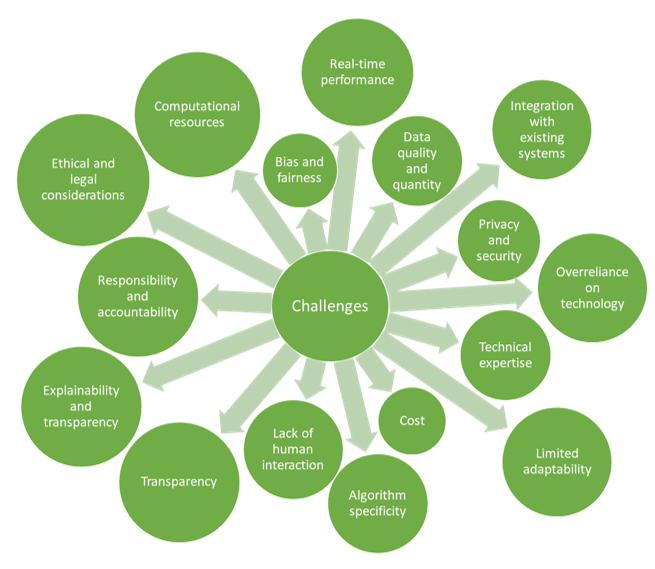
The diagram below, adapted from Velev & Zlatev (2023), highlights the breadth of challenges facing AI system developers and those seeking to integrate the technology. These span an array of areas, from ethics to real-time performance. This article adds to this list by examining regulation before operational issues.
Regulation
“AI is hailed as revolutionary… yet there has been significant resistance to updating legislation and regulation to manage this shift.” (Munn, 2023, p. 872). This resistance is evident as the International Atomic Energy Agency (IAEA) reports that the deployment of AI solutions is hindered due to challenges in demonstrating compliance against regulatory standards, citing the protection of trustworthiness and integrity of AI (IAEA, 2022).
In Feb 2024, the UK government produced a regulatory framework focusing on safety and security, transparency and explainability, fairness, accountability and governance, and contestability (DSIT, 2024). The Office for Nuclear Regulation’s (ONR) response stated that organisations can adopt innovative technologies provided justifications are in place to ensure nuclear safety and security, but acknowledges regulatory shortfalls. As of April 2024, there had been no use of AI in the delivery of critical nuclear safety or security functions within the nuclear sector (ONR, 2024).
Decision-Making
Research by Boyacı et al. (2024) indicates that while incorporating machine-based predictions generally enhances overall decision accuracy, it can increase certain error types, such as false positives, and increase cognitive load. Notably, for our context, these effects are more pronounced when decision-makers are under time pressure, which could result in hesitation when time is critical.
To further complicate matters, a 2020 study presented evidence that emergency managers who experience high levels of digital information overload also experience high levels of psychological stress, leading to poor performance (Misra et al.).
Overreliance
Linked to these psychological impacts, recent research showed that people tend to over-rely on AI, even though it may lead to undesired results. Strangely, this was more prevalent when the advice contradicted available information or the decision maker’s own assessment (Klingbeil et al., 2024).
Other sources have closely linked trust into the equation, stating that high trust can lead to over-reliance on and thus misuse of AI, especially if a decision maker fails to notice an error (Solberg et al., 2022).
Integration and Training
From experience, I have seen how technology can hamper a response. I witnessed a team struggle to operate as nobody could work the new smart boards, resulting in a quick decision to switch to the fall-back method of whiteboards and markers. This raises broader questions on technology integration and training. Generally, high–hazard industries' emergency teams are not professional emergency responders; it is a secondary task. Should their limited training time be focused on working with a piece of technology or thinking through a problem? There are also system reliability concerns resulting in a requirement for contingency arrangements.
Accountability
From a legal perspective, AI outputs must be interpreted by emergency leaders who retain accountability for the decisions made. However, would they not have a good argument in court if they were advised on a specific course of action? To push this further, what if they use an unexplainable AI model, such as a neural network? If one does not understand how the model came up with the prediction, can it really be trusted?
AI Benefits
With a Cambridge University study demonstrating that ChatGPT-4 can surpass the scores of expert ophthalmologists in some areas (Thirunavukarasu et al., 2024), it is not surprising that AI integration is growing. A McKinsey survey showed that for the last 6 years, AI adoption among respondents hovered around 50%, whereas in 2024, it jumped to 72% (McKinsey, 2025). We will focus on examples of how AI can be used operationally to help leaders respond to emergencies.
The Power of Statistics
In 1954, Meehl argued that simple mathematical formulas often make better predictions than professionals. This laid the foundation for hundreds of studies that further demonstrated the power of statistical predictions. In the now-famous Thinking Fast and Slow, Kahneman (2012) stated that these outcomes were due to other stimuli that hamper humans' thoughts and actions. One can see the issue here for emergency leaders who are bombarded with information, alarms and signals.
We know that stress significantly impacts emergency management performance, affecting information processing and decision-making capabilities (Paton, 2003). Unlike human decision-makers, AI systems apply criteria consistently, free from fatigue, bias (if trained sensibly), or emotional stress, leading to better outcomes.
Data Analysis
A study by Sun et al. (2020) looked at the applications of AI in disaster management. They take a measured view of AI’s potential, acknowledging that while it can transform disaster management, it will not replace the “experience and wisdom of well-trained disaster professionals, at least in the foreseeable future.” They see AI’s strengths in analysing big data and performing predictive analytics to support decision-making. This is relevant for high-hazard industries where the volume and complexity of data often exceed human analytical capabilities. In time-critical scenarios, AI can process sensor feeds, weather data, and operational inputs in seconds, far faster than a human-led team could manage.
Broad utility
Across the disaster cycle, we have seen significant strides in the use of AI. Humanitarian Teams are using AI to scope earthquake damage in Turkey and Syria (Ryan-Mosley, 2023), while deep learning models support plume tracking in chemical plants (Shi et al., 2023). Positive research has also been made in understanding fire spread, with AI being applied to predict wildfire behaviour (Khanmohammadi et al., 2024) and the development of an AI Digital Fire System (Zhang et al., 2022).
Conclusion
One could argue that the integration of AI is inevitable. This article has shown that AI can enhance human capability by offering fast, consistent, data-driven support, not to replace human judgment but to inform it. In high-hazard industry where time is critical, this technology could prove invaluable.
However, many challenges remain. These challenges are far-ranging and include ethics, accountability, regulation, safety, and operational delivery. Therefore, progress will require investment, careful design, and collaboration between academia, developers, operators, emergency professionals, and regulators. Explainable AI must also form the basis of any system to build trust and mitigate concerns.
We (Berwicks) are pushing the boundaries and have developed an AI prototype designed to support emergency leaders. One hopes that if we can remain cognisant of the many challenges, engage with the right people and remain focused on the benefits, we will end up with a system that can protect businesses but, more importantly, save lives.
Jonny Price
Berwicks
References
Boyacı, T., Canyakmaz, C., & de Véricourt, F. (2024). Human and machine: The impact of machine input on decision making under cognitive limitations. Management Science, 70(2), 1258–1275.
Department for Science, Innovation & Technology (2024) A pro-innovation approach to AI regulation: government response. HM Government.
International Atomic Energy Agency. (2022). Artificial Intelligence for Accelerating Nuclear Applications, Science and Technology.
IBM.(2025). What is AI? Retrieved from https://www.ibm.com/think/topics/artificial-intelligence
Kahneman,D. (2012). Thinking, fast and slow. Penguin Books.
Khanmohammadi, S., Cruz, M. G., Perrakis, D. D. B., Alexander, M. E., & Arashpour, M.(2024). Using AutoML and generative AI to predict the type of wildfire propagation in Canadian conifer forests. Ecological Informatics, 82, 102711.
Klingbeil, A., Grützner, C., & Schreck, P. (2024). Trust and reliance on AI — An experimental study on the extent and costs of overreliance on AI. Computers in Human Behavior, 160, 108352.
McKinsey& Company. (2024). The state of AI. Retrieved fromhttps://www.mckinsey.com/capabilities/quantumblack/our-insights/the-state-of-ai
Meehl, P. E. (1954). Clinical versus statistical prediction: A theoretical analysis and a review of the evidence. University of Minnesota Press.
Misra,S., Roberts, P., & Rhodes, M. (2020). Information overload, stress, and emergency managerial thinking. International Journal of Disaster Risk Reduction, 51, 101762.
MIT Technology Review. (2023). How AI can actually be helpful in disaster response. Retrieved from https://www.technologyreview.com/2023/02/20/1068824/ai-actually-helpful-disaster-response-turkey-syria-earthquake/
Munn,L. (2023). The uselessness of AI ethics. AI and Ethics, 3(3), 869–877.
Office for Nuclear Regulation. (2024). ONR’s pro-innovation approach to AI Regulation.
Paton, D. (2003). Stress in disaster response: A risk management approach. Disaster Prevention and Management, 12(3), 203.
RESIST.(2025) https://resist-project.eu/story/argos-revolutionising-meteorological-emergency-management-in-catalonia/
Solberg, E., Kaarstad, M., Eitrheim, M. H. R., Bisio, R., Reegård, K., & Bloch, M.(2022). A conceptual model of trust, perceived risk, and reliance on AI decision aids. Group & Organization Management, 47(2), 187–222.
Sun, W., Paolo, B., & Davison, B.D. (2020). Applications of artificial intelligence for disaster management. Natural Hazards, 103(3), 2631–2689.
Shi, J., et al. (2023). Real-time plume tracking using transfer learning approach.Computers & Chemical Engineering, 172, 108172.
Thirunavukarasu,A. J., Oakley, J. D., Zhang, S., Liu, R., Lang, S. J., Kho, J. S., & Keane, P. A. (2024). Large language models approach expert-level clinical knowledge and reasoning in ophthalmology: A head-to-head cross-sectional study. PLOS Digital Health, 3(4), e0000341.https://doi.org/10.1371/journal.pdig.0000341
Velev D., & Zlateva, P. (2023). Challenges of artificial intelligence application for disaster risk management. Copernicus GmbH.
Zhang,T., Wang, Z., Zeng, Y., Wu, X., Huang, X., & Xiao, F. (2022). Building artificial-intelligence digital fire (AID-Fire) system: A real-scale demonstration. Journal of Building Engineering, 62, 105363.


.jpeg)


© Berwicks 2026.
Berwicks is registered with Companies House at
6 Logie Mill, Beaverbank Business Park, Edinburgh,
Lothian EH7 4HG in United Kingdon.
Company Number SC257822.
Website designed and built by Transform Comms